|
Tahoe Nugget #57:
Donner Party: Starved Camp (2 Photos )
March 16, 2006
The principle reason for the demise of nearly half of the 81 pioneers in the Donner Party was starvation, not weather. The emigrants had failed to protect their livestock from the arrows of Indians in present-day
Nevada. A large and important food source was slowly lost when the pioneers were compelled to leave their wounded cattle behind as they rolled their wagons west. When they reached snow-covered Donner Pass at the end
of October they realized that they were not getting their wagons or themselves over the mountains any time soon. The party built shelters in November 1846, but none of them were expecting to spend the next 3 ½
months waiting for help. No one in California knew that the pioneers were trapped high in the mountains or that they had lost most of their cattle.
James Reed, who had been banished from the Donner Party
earlier for killing a man, had reached California before snow closed Donner Pass. He attempted to organize a rescue operation to save his family and friends trapped east of the mountains, but the Mexican-American
War was in full swing and all American men in California were focused on the conflict. Reed, a veteran officer, was drafted into the fight for a time.
The snowbound pioneers were on their own. Desperate for
help, 15 men and women snowshoed out of the mountains. They carried enough food for one week's travel — it took them a month to reach the first settlement in the Sacramento Valley. Their journey out of the
storm-wracked Sierra reads like a dark, lurid nightmare and we won't discuss it here.
It took three heroic relief efforts to rescue most of the surviving pioneers out of their encampments. James Reed led
the Second Relief operation during the first two weeks of March 1847. It took Reed and a fellow rescuer two days to get 17 of the starving emigrants (including 14 young children) to Summit Valley just west over
Donner Pass. At Summit Valley, the group was overwhelmed by a violent blizzard. The pioneers had virtually no food and were completely exposed to the intense storm. When the storm finally abated, 14 of the emigrants
were too weak to travel and were left beside a roaring fire. Reed struggled on with his two children and another youngster who was strong enough to walk.
When the Third Relief arrived at "Starved
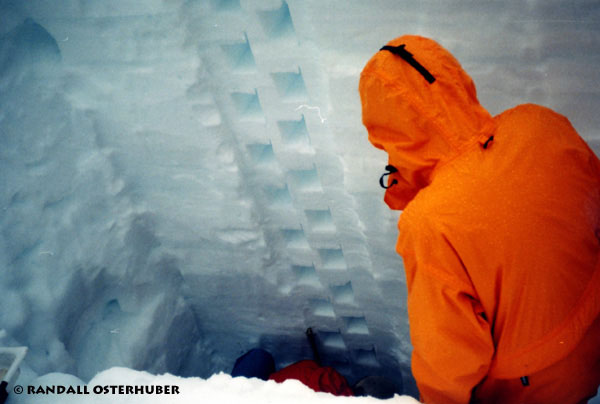
Camp" a few days later, three of the emigrants were dead and the rescuers found evidence of cannibalism. The survivors were lying at the bottom of a 24-foot deep pit, huddling next to a smoldering fire that had
melted through the snowpack. The men in the Third Relief couldn't stay (they were on their way east to find the last of the survivors at the encampments), but John Stark, a strong 220-pound man, decided that
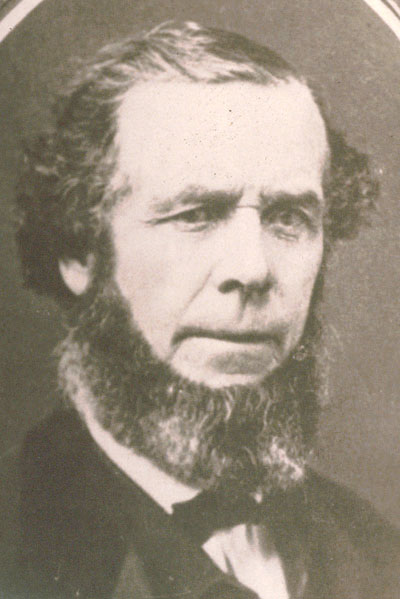
someone must help them. One of the unsung heroes of the Donner Party story, Stark single-handedly carried two, sometimes three children at a time, as well as all the provisions and blankets. His courage, strength
and determination led the survivors of Starved Camp to safety (two adults and seven children) and to their successful future in California. Intelligent and well-liked, Stark later served as a judge, legislator and
sheriff of Napa County.
Photo #1: Snow pit at the Central Sierra Snow Laboratory gives a sense of the deep Sierra snowpack. The CSSL is located not far from the site of Starved Camp.
Photo #2: John Stark had the strength of two men. He told the children that he could carry them all, if there was room on his back, because they were so light from starvation.
|